Mechanical Issues Nobody Checks Before Buying an Older House
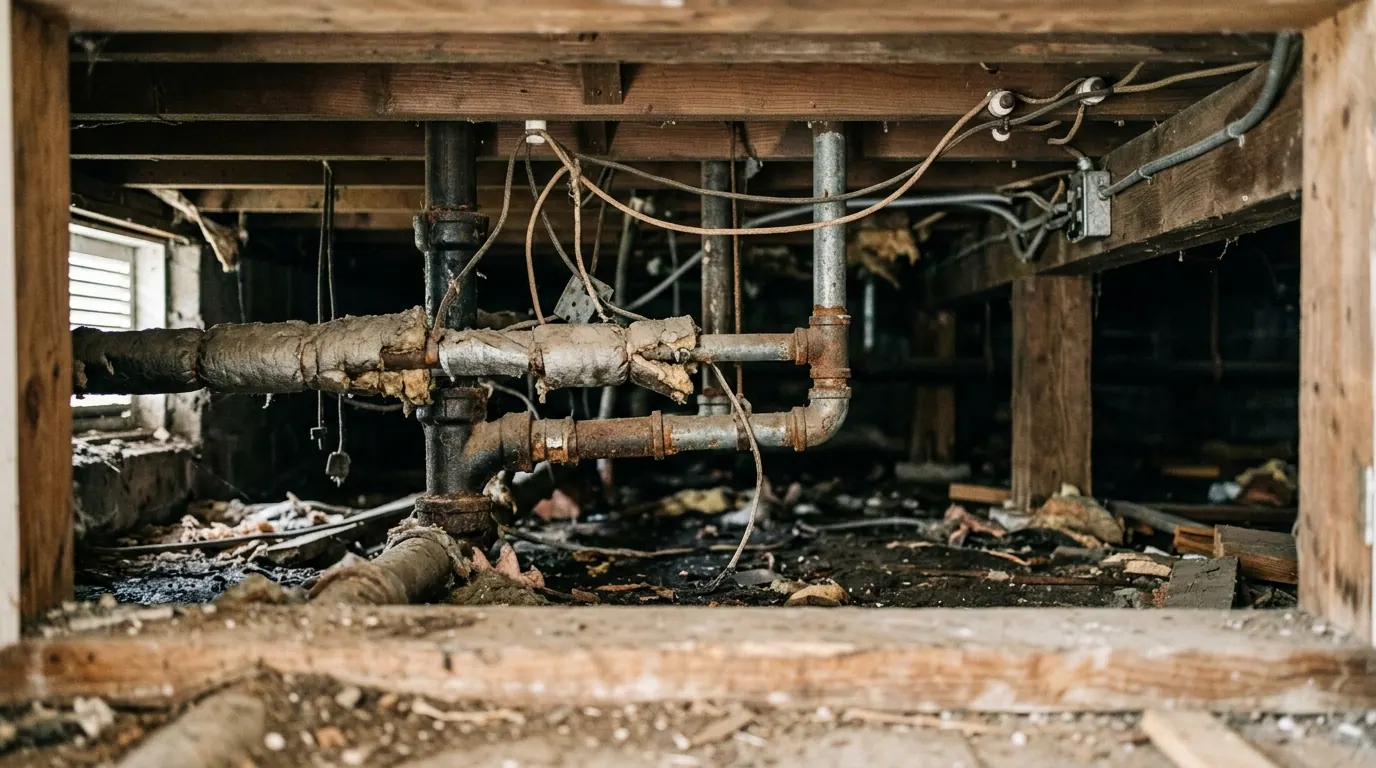
Generated (Gemini), via Wikimedia Commons
Most buyers walk an older house looking at floors, paint, and whether the kitchen needs gutting. The expensive problems are usually behind the walls and under the floor: the electrical panel, the pipes, the furnace, and the duct or vent system nobody opens up during a showing. A pre-purchase mechanical check adds maybe $400 to $800 on top of a standard home inspection, and it can save you from a $15,000 to $30,000 surprise in the first two years of ownership.
This is written for someone buying a house built before roughly 1985, where original mechanicals are common and partial updates are even more common. Partial updates are often the real danger, because they look modern on the surface while half the system underneath is original.
What you need
- A flashlight and a phone camera, for panels, crawlspaces, and attics
- A voltage tester or non-contact tester, cheap ones run $10 to $20
- A notepad or voice memo app to log panel labels, pipe materials, and furnace age tags
- A licensed home inspector who will actually go into the crawlspace and attic, not just the ones who peek from the hatch
- A separate electrician or plumber for a specialist walkthrough, if the general inspection raises flags
- The seller's disclosure and any permit history from the city or county building department
Step by step
1. Open the electrical panel and read what's actually in it. Look for the brand and age. Federal Pacific Electric (FPE) panels and early Zinsco panels, both common from the 1950s through the 1970s, have documented breaker failure problems where breakers don't trip under overload. These are not automatically dangerous in daily use, but insurers increasingly refuse to write policies on them, and replacement runs $1,800 to $3,500 depending on service size. Also check the amperage rating stamped on the main breaker. A lot of older homes still run on 60 or 100 amp service, which was fine for a house with no central air, no electric dryer, and no home office full of chargers. Upgrading to 200 amp service with a new panel and possibly a new service drop from the street runs $2,500 to $6,000 in most markets.
2. Trace the water supply pipe material from the street to the fixtures. Houses from the 1960s through early 1980s sometimes used polybutylene supply pipe, which is prone to failure at the fittings and is a known insurance red flag in some states. Older galvanized steel pipe corrodes from the inside and restricts water flow over decades, even if it's never leaked yet. You can often spot galvanized pipe by its dull gray color and the fact that a magnet sticks to it, unlike copper or PEX. Full repipe of a typical three-bedroom house runs $4,000 to $12,000 depending on access and number of fixtures.
3. Check the furnace or boiler tag for age and look at the heat exchanger access. Furnaces typically last 15 to 25 years, boilers often longer. A furnace nearing 20 years old isn't an emergency, but budget for replacement in the near term, $4,000 to $8,000 for a mid-efficiency gas furnace installed. More urgent is a cracked heat exchanger, which can leak carbon monoxide into the air supply. A technician needs a camera scope to check this properly, it's not something you confirm with a flashlight. If the house has an older furnace and no obvious CO detector nearby, that's worth asking the inspector to specifically flag.
4. Look at the water heater, the sewer line, and the HVAC ductwork together, since they often fail as a group in houses that haven't been touched in 30 years. A water heater past 10 to 12 years is a candidate for replacement regardless of how it looks. For the sewer line, ask specifically for a camera scope inspection, standard home inspections do not include this and it costs $200 to $500 extra. Clay or cast iron sewer lines common in older construction crack and get infiltrated by tree roots, and a full sewer line replacement from house to street runs $5,000 to $15,000 or more depending on depth and length. For ductwork, old asbestos-wrapped duct insulation shows up in houses from the 1950s and 60s and needs to be left alone or professionally abated, not disturbed during a casual renovation.
Where this goes wrong
The most common mistake is treating the home inspection as the mechanical inspection. A standard general inspector looks at systems for obvious defects and functional operation, they turn on the furnace and see if heat comes out, they flip breakers and see if power cuts. They are not going to scope the sewer line, pull the panel cover off an FPE panel and research its recall history, or run a load calculation on your electrical service. Buyers who skip the add-on inspections find out about these problems when the furnace dies in January or the sewer backs up during the first heavy rain.
Another failure mode is assuming a "updated" listing means fully updated. A lot of flips and quick sales get a new water heater and a repainted panel cover, while the galvanized pipe from the street is untouched, or the original 60 amp service feeds a brand new subpanel that was added for a kitchen remodel. Partial work is common precisely because full mechanical replacement is expensive and invisible once the walls are closed up. Ask for permits on any electrical or plumbing work claimed in the listing. No permit usually means no inspection happened, which means no guarantee the work meets code.
A third problem is underestimating how these systems interact with your renovation budget. If you're planning a kitchen remodel and the house has 60 amp service, you may not be able to add the appliances you want without an electrical upgrade first, which changes your project order and your financing needs. If the sewer line is marginal, a bathroom addition that adds fixture load can push it into failure sooner. Mechanical problems rarely stay isolated once you start opening up a house.
When to stop and call someone
Do not open an electrical panel cover if you are not comfortable around live electrical components, even just to look. A non-contact voltage tester and a flashlight through the open door is reasonable for a buyer; removing the dead front cover to inspect breakers should be done by an inspector or electrician who knows what they're looking at and how to do it safely.
Do not attempt to diagnose a cracked heat exchanger or assess combustion safety yourself. This requires a combustion analyzer and a trained technician, and carbon monoxide risk is not something to guess about.
Do not skip a sewer scope on any house built before 1990, especially with mature trees on the property, just to save $300. It is one of the cheapest ways to avoid one of the most expensive repairs.
Call a licensed electrician before closing if you find an FPE or Zinsco panel, knob-and-tube wiring, or any amperage under 100 amps feeding a house with central air or electric heat. Call a plumber before closing if you find polybutylene pipe or extensive galvanized pipe runs. In both cases you want a real quote in hand before you negotiate price or walk away, not a guess.
None of this means walk away from every older house. It means price the mechanicals into your offer the same way you'd price a bad roof, because that's really what they are: expensive, often invisible, and fully knowable if you look in the right places before you sign. Fixer Files has covered individual projects like panel upgrades and repipes with real cost breakdowns, worth a look once you know which systems in your specific house need attention.
Get the real numbers
Every renovation post includes the actual costs. Join the list and get each new breakdown as it goes up.
Join the list