Before and After: A $40,000 Flip on a 1970s Ranch
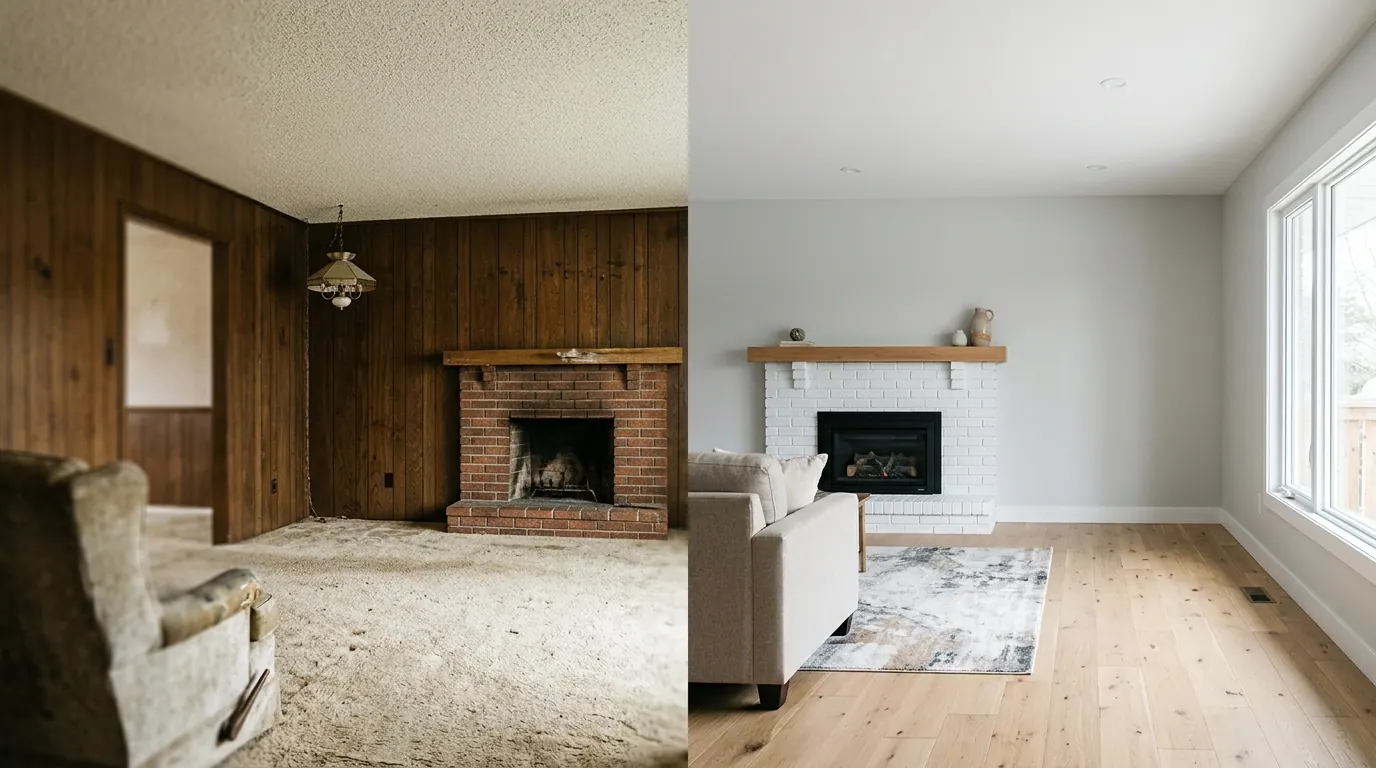
Generated (Gemini), via Wikimedia Commons
A $40,000 budget on a 1970s ranch buys a cosmetic-plus flip, not a gut job. That number typically covers flooring, paint, kitchen refresh, one or two bathroom updates, and fixing whatever the inspection turns up, but it does not stretch to moving walls or replacing a roof. Here is what that budget actually looks like in practice, and where it commonly breaks.
Key takeaways
- A **$40,000 budget** on a ranch this age is a cosmetic-and-systems flip, not a structural one.
- **Kitchens and bathrooms** eat the largest share, usually **35-45% of the total budget** combined.
- **Flooring** across a typical 1,200-1,600 sq ft ranch runs **$4,000-$9,000** depending on material.
- **Contingency of 10-15%** is not optional on a house this age; something behind a wall will need money.
- Margins on a flip this size are thin enough that **one bad surprise can erase the profit**.
What does a 1970s ranch actually need at this budget level?
Ranches built in the 1970s share a predictable set of problems. Single-pane aluminum windows, outdated electrical panels (often 100 amp, sometimes with Federal Pacific or Zinsco panels that need full replacement for safety and insurability), original cast iron or galvanized plumbing, and layouts with small, closed-off kitchens. A $40,000 budget generally cannot fix all of that. It has to prioritize.
On a typical job at this price point, the money usually goes toward things buyers see and touch first: flooring, paint, kitchen counters and cabinet fronts or full replacement if the budget allows, one bathroom fully redone, light fixtures, and curb appeal. Anything invisible, like knob-and-tube wiring hiding behind that one outlet that does not work, gets fixed only if it is found and only if there is money left after the visible work.
A realistic split for a $40,000 project looks something like this:
- Kitchen: $12,000-$16,000 (refresh with new counters, hardware, appliances, and cosmetic cabinet work rather than full replacement)
- Bathroom(s): $6,000-$10,000 for one full update
- Flooring: $4,000-$9,000 depending on square footage and whether it is LVP, refinished hardwood, or tile
- Paint, interior and exterior: $3,000-$6,000
- Fixtures, lighting, hardware: $1,500-$3,000
- Contingency and permit fees: $3,000-$6,000
Notice what is missing: roof, HVAC, and foundation. If any of those need work, the budget either grows past $40,000 or something else gets cut. That tradeoff is the honest reality of a fixed-budget flip, and it is the single most common reason projects go over.
Where does the money actually go, room by room?
The kitchen is almost always the biggest line item, and for good reason. Buyers judge a house heavily on the kitchen and it shows in appraisal and showing feedback. On a $40,000 total budget, a full kitchen gut with custom cabinets is off the table. What works instead is refacing or repainting existing cabinet boxes, swapping doors and hardware, replacing laminate counters with a mid-range quartz or a durable laminate that looks like stone, and updating the backsplash and lighting. Appliances get replaced if they are visibly dated, usually with a matching stainless package in the $2,000-$3,500 range for a basic set.
Bathrooms are the second biggest spend. A 1970s ranch usually has a pink, blue, or avocado-tiled bathroom that reads as dated the second a buyer walks in. Retiling a tub surround, replacing the vanity, toilet, and light fixture, and re-grouting or replacing floor tile runs $6,000-$10,000 per bathroom on the update end, not a full teardown. If the house has two bathrooms and both need work, that alone can consume a third of the total budget, which is why many flips at this price point only fully redo one bathroom and do a lighter refresh (paint, hardware, new toilet) on the second.
Flooring across the whole house matters more to buyers than any single room upgrade because it ties the house together visually. Luxury vinyl plank has become the default choice for flips at this budget because it is durable, waterproof, and runs $3-$6 per square foot installed, compared to $8-$12 for refinished or new hardwood. On a 1,400 sq ft ranch, that is the difference between roughly $5,000 and $12,000 just for flooring, which is a meaningful swing in a $40,000 budget.
What commonly goes wrong on a project like this?
The most common budget-killer on a 1970s ranch is what gets found once flooring comes up or a wall gets opened. Original subfloors from this era are sometimes particle board rather than plywood, and if it has ever taken on moisture, it needs replacement before new flooring goes down. That is not optional and it is not cheap to skip; installing over a soft or water-damaged subfloor leads to squeaks, sagging, and flooring failure within a year or two.
Electrical panels are the second common surprise. A house from this era with its original panel, especially a Federal Pacific Stab-Lok panel, is a known fire risk and many insurers will not write a policy on a house with one still installed. Replacing a panel runs $2,000-$4,000 depending on amperage and whether the service line also needs upgrading. If this was not budgeted from the start, it comes directly out of the contingency fund, and on a $40,000 job, that is 5-10% of the entire budget gone in one line item.
Plumbing is the third. Galvanized pipe from this era corrodes from the inside out, and low water pressure at the fixtures is often the first sign. A full repipe of a single-story ranch with PEX runs $4,000-$10,000 depending on the number of fixtures and wall access. Flippers sometimes gamble and leave old galvanized supply lines in place behind new tile, which is a corner that shows up as a leak for the next owner within a few years. It is the kind of shortcut that saves money today and costs someone else money later, and it is worth calling out because it happens more than people admit.
Permits are the other quiet budget item that gets skipped and then bites back. Electrical panel swaps, some plumbing work, and any structural change typically require a permit and inspection. Skipping permits to save $300-$800 in fees is common on small flips, but it creates a real problem at resale: many buyers' agents and inspectors now specifically ask whether recent electrical or plumbing work was permitted, and unpermitted work can slow or kill a sale, or force it into a price reduction.
Does the math actually work out?
Whether a $40,000 renovation makes financial sense depends entirely on the after-repair value relative to the purchase price, and this is where a lot of first-time flippers get the math backward. A common rule of thumb in the flipping world is the 70% rule: purchase price plus repair costs should not exceed about 70% of the after-repair value, leaving room for closing costs, holding costs, and profit.
As an example using round numbers rather than a specific job: if a 1970s ranch in a market where comparable renovated homes sell for $280,000 can be bought for $155,000, and the renovation genuinely costs $40,000, the total investment is $195,000, which is about 70% of $280,000. That leaves roughly $85,000 of spread before accounting for holding costs (property taxes, insurance, utilities, and loan interest if the purchase was financed), closing costs on both ends (typically 6-10% of sale price combined), and any budget overruns.
Holding costs are the part first-time flippers most often underestimate. A renovation that takes four months instead of the planned two adds two extra months of taxes, insurance, and interest, which on a modestly priced house can easily run $1,500-$3,000 per month depending on financing. A project that goes from a planned two months to five months, which is common when unpermitted surprises or contractor scheduling issues show up, can quietly erase $5,000-$10,000 of profit before a single dollar of renovation overrun is even counted.
The honest takeaway is that the renovation budget is only half the equation. The purchase price has to leave enough margin to absorb both renovation overruns and time overruns, because on a project this size, both are likely, not just possible.
What should a first-time flipper prioritize with a limited budget?
When the budget cannot cover everything a 1970s ranch needs, the priority order that tends to protect resale value best is: safety and systems first, then kitchen, then flooring, then bathrooms, then cosmetics. That order sometimes surprises people because kitchens and bathrooms get all the attention on renovation shows, but an inspection that turns up a dangerous panel or active plumbing leak will scare off buyers and their lenders regardless of how nice the counters look.
Cosmetic work that returns the most value per dollar on a house this age includes fresh paint throughout (one of the highest return-on-cost items in any renovation), updated light fixtures and hardware, and decluttering the yard and entry for curb appeal. These are the items that cost a few hundred to a few thousand dollars total but change a buyer's first impression more than almost anything else on the list.
It is also worth being honest about what a $40,000 budget cannot do. It generally cannot open up a closed floor plan, cannot replace a roof that is at the end of its life (a full reroof on an average ranch runs $8,000-$15,000 depending on materials and region), and cannot address a failing HVAC system (a full system replacement typically runs $6,000-$12,000). If any of those three things are needed, they usually have to come out of the purchase price negotiation rather than the renovation budget, meaning the house needs to be bought cheaper to leave room for them.
FAQ
Is $40,000 enough to flip a 1970s ranch?
It is enough for a cosmetic-and-systems flip that includes kitchen and bathroom updates, flooring, and paint, as long as the roof, HVAC, and major structural systems are already in reasonable shape. If those big-ticket items need replacement, the effective budget needed rises significantly, often into the $55,000-$70,000 range.
What is the single biggest budget risk on a house this age?
Hidden electrical and plumbing issues behind walls and floors are the most common source of overruns, because they are only found once demolition starts and they are not optional to fix. A contingency fund of at least 10-15% of the total budget is the standard way to protect against this.
Should unpermitted work ever be an option to save money?
No. Skipping permits on electrical panel work, plumbing changes, or structural changes can save a small amount up front but creates real resale risk, since inspectors and buyers' agents increasingly ask about permit history, and unpermitted work can delay or derail a sale.
The bottom line
A $40,000 renovation on a 1970s ranch can produce a genuinely nice, sellable house, but only if the purchase price left enough margin to cover the parts of the budget that are not glamorous: subfloor repair, panel upgrades, permits, and a real contingency fund. The kitchen and bathrooms get the attention, but it is the boring line items that decide whether the numbers actually work out in the end. Readers who want more real, itemized breakdowns like this one can find them across the rest of Fixer Files.
Get the real numbers
Every renovation post includes the actual costs. Join the list and get each new breakdown as it goes up.
Join the list