Tile Yourself or Hire a Pro? What We Learned Doing Both
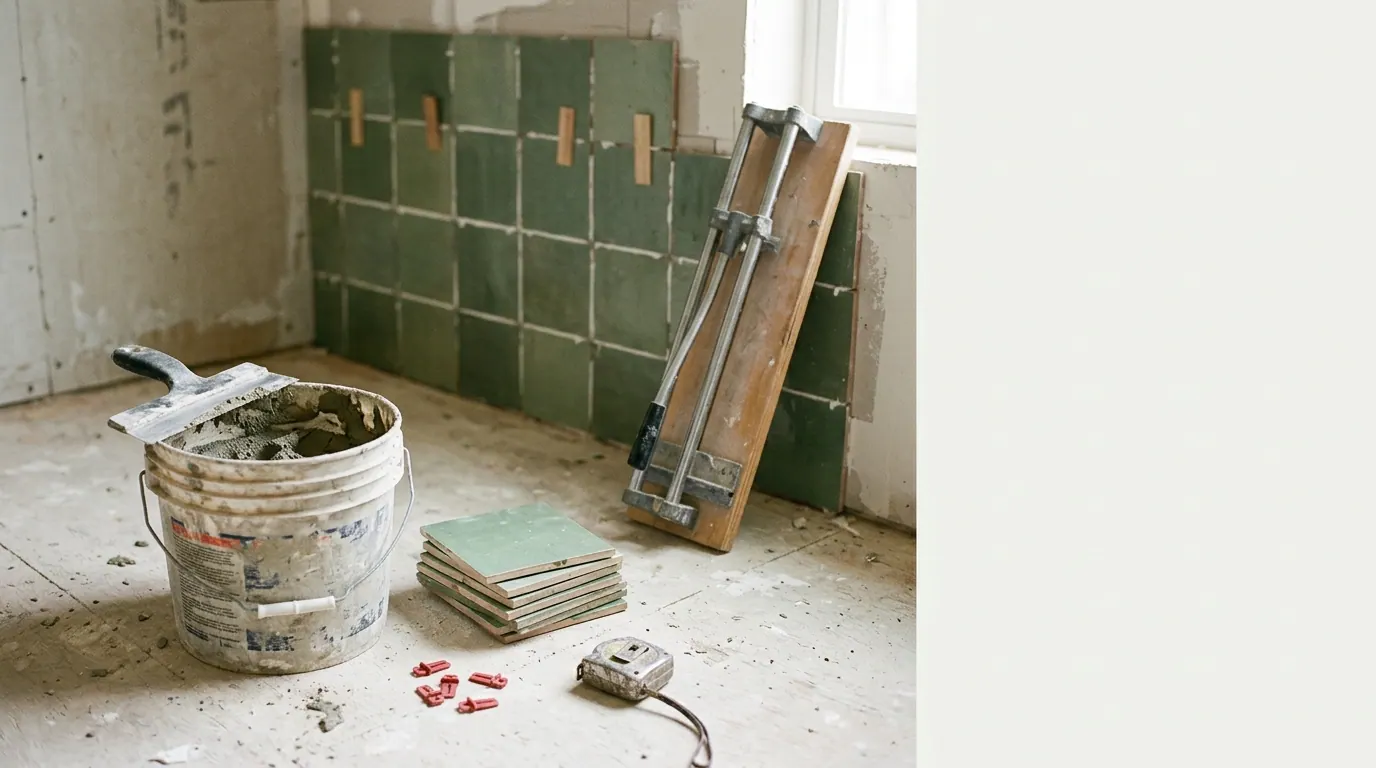
Generated (Gemini), via Wikimedia Commons
We've tiled floors ourselves and we've paid pros to tile showers. Both were the right call, just not for the same job. If you're deciding which way to go, the short version is this: DIY makes sense for flat, dry, low-stakes areas like a laundry room floor or a simple backsplash. Hiring out makes sense for anything wet, anything with a steep learning curve like a curbless shower, or anything on a flip timeline where your labor hour is worth more spent elsewhere.
Decide this first
The one question that decides everything else is: what happens if this tile job fails in two years? A crooked backsplash is ugly. A shower pan that leaks behind the wall rots framing and grows mold you can't see until the drywall is soft. Wet areas carry real consequences if the waterproofing is wrong. Dry, low-traffic areas mostly carry cosmetic risk. Sort your project into one of those two buckets before you think about cost or time at all.
What to look for
Total cost, not just materials
Tile itself is often the cheapest part of the job. A mid-range porcelain tile runs roughly $2 to $8 a square foot. Thinset, grout, backer board, waterproofing membrane, spacers, and trim pieces add another $1.50 to $3 a square foot in materials whether you DIY or hire out. The real gap is tools and labor. A pro crew usually charges $8 to $20 a square foot for installation labor alone, more for herringbone patterns, large format tile, or curbless showers. DIY skips that labor cost but you'll spend $150 to $400 on tools you may only use once: a wet saw, a good notched trowel set, a level, spacers, a mixing paddle. Rent instead of buy if this is a one-time job. Factor in that a first attempt often wastes 10 to 15 percent more tile than a pro job does, from cut mistakes and breakage.
Time and what your time is worth
A pro crew can tile an average bathroom floor in a day and a shower surround in one to two days, membrane and all. A first-time DIYer doing the same shower should expect three to five days spread over a week or two, because you're waiting on thinset cure time, waterproofing cure time, and grout cure time between steps, and you're moving slower because you're checking your work. If you're a flipper paying holding costs on a property, that extra week has a real dollar value. If it's your own home and you're not on a deadline, the time cost is mostly patience, not money.
Quality and resale expectations
Buyers and inspectors don't grade tile work by feel, they look at specific things: consistent grout lines, level tile across a run, properly sloped shower floors so water drains instead of pooling, and no lippage (where one tile edge sits higher than its neighbor). A careful first-time DIYer can hit an acceptable standard on a floor or backsplash. Showers are less forgiving because the waterproofing has to be right and it's invisible once tiled over. If resale is the goal, a shower that leaks in year two costs far more to fix than it would have cost to hire a pro up front.
What to ignore
Skip the marketing around premium trowels, laser leveling tools, and specialty tile-leveling clip systems unless you're doing large format tile (anything over 15 inches) or a big floor area. For a small backsplash or a standard 12x12 floor, a basic notched trowel and a level do the job fine. Self-leveling underlayment gets pushed hard by big box stores, but most floors don't need it unless the subfloor is genuinely out of level by more than 1/4 inch over 10 feet. Check that with a long level before you buy a bag of it. Also ignore claims that a specific grout brand is dramatically more "waterproof" than another. Modern grouts are all reasonably water resistant when sealed properly; the membrane behind the tile is what actually keeps water out, not the grout brand on the surface.
Common mistakes
The most expensive DIY mistake we've seen, in our own work and in other people's, is skipping or shortcutting the waterproofing membrane in a shower to save time. It's tempting because it's the one step nobody sees once tile goes up. But it's also the step that determines whether the wall behind the tile lasts 20 years or rots in three. If you're DIYing a wet area, do not skip this step to save a weekend, and don't trust green board (moisture-resistant drywall) alone behind tile in a shower. It needs a proper membrane or cement backer board with a liquid waterproofing coat.
The second common mistake is using the wrong thinset for the tile size. Large format tile (anything over about 15 inches) needs a modified, large-format-rated thinset and usually back-buttering the tile in addition to combing the floor or wall. Standard thinset and standard technique on big tile leads to hollow spots, which show up later as cracked tiles or a hollow sound when you tap the surface. This mistake shows up in both DIY and rushed pro jobs, so it's worth asking a contractor directly what thinset they plan to use if you're going with large tile.
The third mistake, more common on the hiring side, is picking a contractor purely on the lowest quote without asking how they handle waterproofing and slope in wet areas. A cheap quote that skips a proper shower pan or uses a thin, unrated membrane will look identical to a correct job on installation day. The difference only shows up later, in a stain on the ceiling below or a soft spot in the shower floor. Ask for the specific products they use and how many similar jobs they've done, not just a price.
FAQ
How much does professional tile installation actually cost per square foot, all in?
As a rough range, expect $12 to $30 a square foot total (materials plus labor) for a standard floor or backsplash, and $25 to $60 a square foot for a shower with proper waterproofing, because labor and prep time are higher in a small, detail-heavy space. These are wide ranges on purpose; region, tile choice, and pattern complexity move the number a lot. Get two or three quotes for your specific job rather than trusting a national average.
Can a first-timer really tile a shower themselves?
It's possible, but it's the highest-risk DIY tile project there is, because the failure point is hidden behind the finished surface. If you do attempt it, the honest advice is: buy a proper waterproofing kit system (the kind with a manufacturer's warranty tied to using their membrane and mortar together), follow the slope and drain instructions exactly, and don't rush the cure times between steps. If you're not confident about the shower pan slope or the membrane step specifically, that's the one part worth paying a pro for even if you DIY the rest of the tile setting.
Is it worth hiring a pro just for the tricky parts and DIYing the rest?
Yes, this is a reasonable middle path and we've done it. Paying a pro to build and waterproof a shower pan, then DIYing the wall tile and floor tile elsewhere in the house, gets you the risk protection where it matters most and keeps costs down where the stakes are lower. Just be upfront with the contractor about the split before they quote, since some prefer to do the whole job or not be involved at all.
If you're weighing this decision for your own renovation, the honest answer is that both routes work, they just fit different jobs. That's the kind of real-numbers comparison we try to run on Fixer Files: not which choice sounds better, but which one holds up in two years.
Get the real numbers
Every renovation post includes the actual costs. Join the list and get each new breakdown as it goes up.
Join the list